To provide the best experiences, we use technologies like cookies to store and/or access device information. Consenting to these technologies will allow us to process data such as browsing behavior or unique IDs on this site. Not consenting or withdrawing consent, may adversely affect certain features and functions.
The technical storage or access is strictly necessary for the legitimate purpose of enabling the use of a specific service explicitly requested by the subscriber or user, or for the sole purpose of carrying out the transmission of a communication over an electronic communications network.
The technical storage or access is necessary for the legitimate purpose of storing preferences that are not requested by the subscriber or user.
The technical storage or access that is used exclusively for statistical purposes.
The technical storage or access that is used exclusively for anonymous statistical purposes. Without a subpoena, voluntary compliance on the part of your Internet Service Provider, or additional records from a third party, information stored or retrieved for this purpose alone cannot usually be used to identify you.
The technical storage or access is required to create user profiles to send advertising, or to track the user on a website or across several websites for similar marketing purposes.


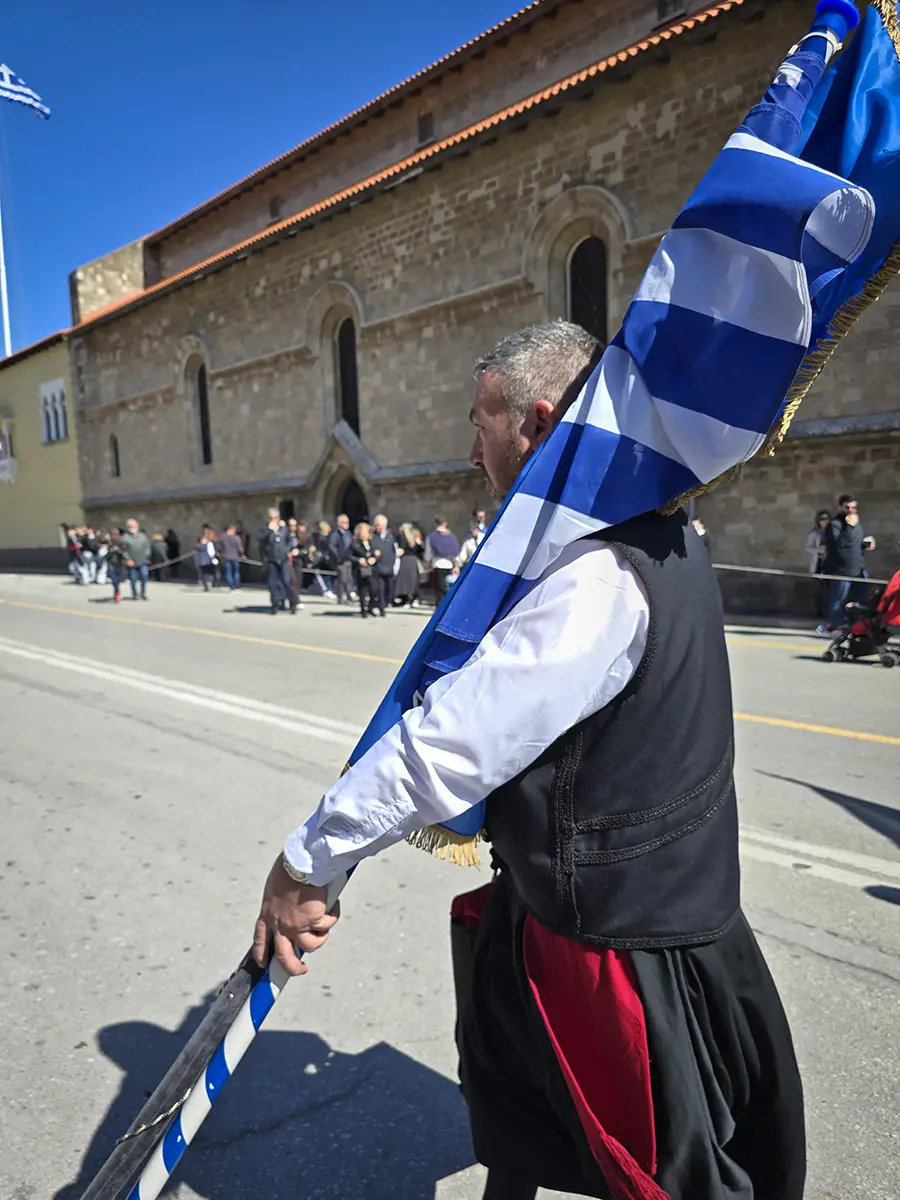
March 7: Celebrating Dodecanese Union with Greece
March 7: Celebrating Dodecanese Union with Greece
Rhodes on March 7 is not the postcard-perfect version defined by beaches and resorts. It is an island that pauses to honor its past and reaffirm its identity. For visitors fortunate enough to be present, the experience becomes something deeper than sightseeing. It is an opportunity to witness the living history of the Dodecanese, to understand the emotional significance of the Dodecanese Union with Greece in 1948, and to connect with the genuine spirit of a place shaped by endurance, culture, and pride.
As it is an official public holiday across the Dodecanese, shops and services remain closed, reinforcing the sense that this day is dedicated to remembrance rather than routine. Chronia Polla Dodekanisa!
The Historical Significance of March 7, 1948
On March 7, 1948, the official ceremony of the Union of the Dodecanese with Motherland Greece took place, marking the end of centuries of foreign rule and sealing a long historical journey shaped by resilience, cultural endurance, and an unwavering sense of identity. For centuries, the islands passed through different rulers. The Knights of St. John, the Ottomans, and later the Italians each left their mark on the region. The Italian occupation, which began in 1912, lasted until 1943. During the turbulent years of World War II, the Dodecanese came under German control until 1945, followed by temporary British administration until 1947. The long-awaited moment finally arrived in 1948, when the islands were officially incorporated into the Greek state, restoring a deep-rooted national and cultural connection.
How Rhodes Commemorates the Union
In Rhodes, the capital of the Dodecanese, this anniversary is observed with particular reverence. For the people of the island, March 7 is not simply a public holiday but a day of memory and pride. Many of us grew up listening to stories from our grandparents about the years of Italian rule and the emotions surrounding the Union. The date carries a strong emotional resonance that transcends formal ceremony; it is part of living memory.
On the morning of March 7, the atmosphere across the island feels distinct. In villages and in Rhodes Town alike, residents gather early, dressed more formally than usual, to participate in commemorative events.
The Parade in Rhodes Town
In Rhodes Town, the official celebrations begin with a solemn doxology at the historic Church of Evangelismos, followed by wreath-laying at the Monument of the Fallen. As the clock approaches eleven, attention turns to Mandraki Harbour, where the grand parade unfolds along the central seafront.
The parade is both dignified and visually striking. Units of the Hellenic Army march alongside students from local schools, cultural associations from across the Dodecanese, and local groups representing villages throughout the island. Traditional costumes add color and character to the occasion, some simple and austere, others elaborately embroidered with vibrant fabrics and detailed craftsmanship. The result is a powerful display of heritage that connects the present generation with centuries of history.
The Atmosphere After the Parade
When the official proceedings conclude, the mood gradually softens. Cafés around Mandraki begin to fill with locals who gather to share coffee, conversation, and reflections on the day. Families often continue their celebrations over lunch, either in the town’s restaurants or in nearby villages. As the date usually falls during the Lenten period, many choose seafood dishes and traditional fasting recipes, especially in seaside tavernas overlooking the Aegean Sea.
This gentle transition from ceremony to everyday island life highlights the unique character of Rhodes. The celebrations are heartfelt and meaningful, yet they remain deeply rooted in community and shared experience.
Visiting Rhodes on March 7
Experiencing Rhodes on March 7 offers a perspective that differs from the island’s well-known summer image. The mild March weather allows for relaxed walks by the sea, while the absence of peak-season crowds creates a more intimate and authentic atmosphere.
Whether you choose to attend the vibrant celebrations of the Union of the Dodecanese, wander through the serene streets of Rhodes Medieval Town, or enjoy a traditional lent meal in seaside tavernas, March in Rhodes offers a truly authentic experience.
More posts