To provide the best experiences, we use technologies like cookies to store and/or access device information. Consenting to these technologies will allow us to process data such as browsing behavior or unique IDs on this site. Not consenting or withdrawing consent, may adversely affect certain features and functions.
The technical storage or access is strictly necessary for the legitimate purpose of enabling the use of a specific service explicitly requested by the subscriber or user, or for the sole purpose of carrying out the transmission of a communication over an electronic communications network.
The technical storage or access is necessary for the legitimate purpose of storing preferences that are not requested by the subscriber or user.
The technical storage or access that is used exclusively for statistical purposes.
The technical storage or access that is used exclusively for anonymous statistical purposes. Without a subpoena, voluntary compliance on the part of your Internet Service Provider, or additional records from a third party, information stored or retrieved for this purpose alone cannot usually be used to identify you.
The technical storage or access is required to create user profiles to send advertising, or to track the user on a website or across several websites for similar marketing purposes.


Sarakosti in Rhodes: Greek Orthodox Lent Explained
Sarakosti in Rhodes: Greek Orthodox Lent Explained
Sarakosti (Great Lent), the Greek Orthodox period of Lent, is one of the most important and meaningful times of the year in Greece. It is a spiritual journey of preparation leading to Easter, the most significant celebration in Christianity. As in the rest of the country, Sarakosti in Rhodes beautifully blends religious tradition with local culture, gastronomy, and customs that come alive across the island.
For travelers visiting Rhodes during Sarakosti, this period offers a rare opportunity to experience the island’s authentic daily life, away from the summer crowds, and to discover local traditions in the weeks leading up to Greek Orthodox Easter.
What Is Sarakosti and When Does It Take Place?
Sarakosti is a period of fasting, self-restraint, and spiritual reflection. It symbolizes the forty days that Jesus Christ fasted in the desert and encourages inner reflection, hospitality, and solidarity—values deeply rooted in Greek culture.
Although Sarakosti lasts 40 days, the full fasting period extends to 48 days, including Holy Week. It starts on Clean Monday (Kathara Deftera) on February 23, 2026, marking the official beginning of fasting, and ends on Holy Saturday, April 11, 2026. Since Easter is a movable feast, the dates of Great Lent also change each year.
In Greece, Sarakosti is always connected with the month of March. There is even a well-known Greek saying: “Is March ever missing from Sarakosti?” It is used to describe something as certain and inevitable.
Sarakosti Food in Rhodes: Traditional Greek Lenten Cuisine
Visiting Rhodes during Sarakosti is the ideal time to discover traditional Greek Lenten cuisine, based on simple yet rich flavors of the Mediterranean diet. Many restaurants across Rhodes adjust their menus during Lent, giving visitors the chance to taste authentic Sarakosti dishes prepared with local ingredients.
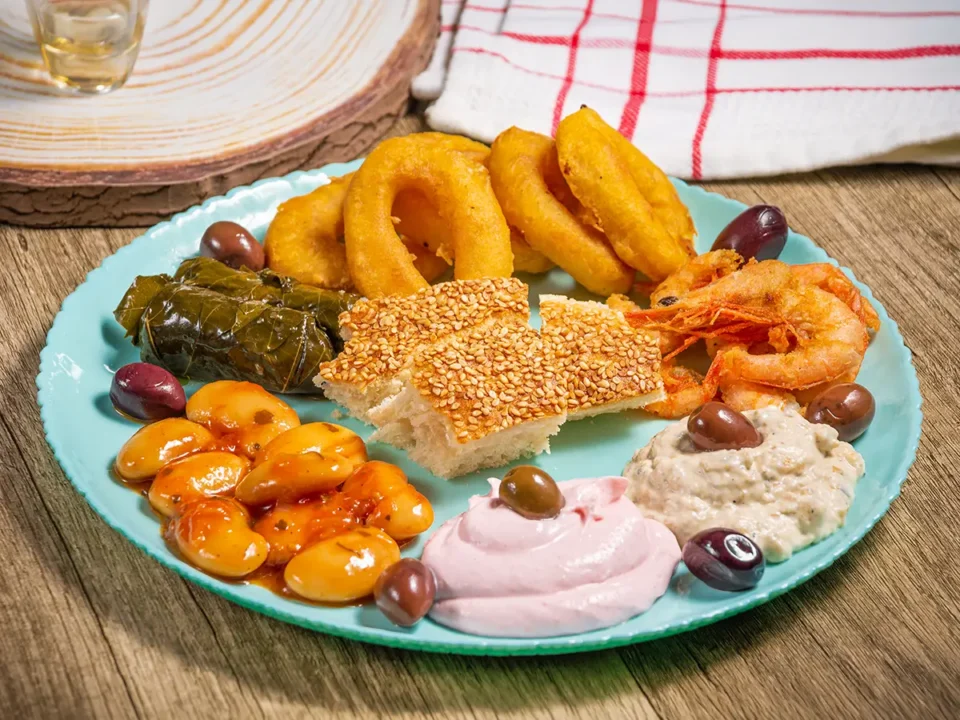
During this time, people steer clear of meat and fish, dairy products, and eggs. Instead, you’ll find tables brimming with legumes, seasonal veggies, olives, and a variety of seafood like octopus, squid, and shrimp.
On Clean Monday (Kathara Deftera), locals celebrate the beginning of Sarakosti with traditional foods such as lagana bread, taramosalata, halva, and a variety of seafood. The day is often spent outdoors with picnics, music, and the joyful custom of kite flying, a scene you’ll see across beaches and open spaces around the island.
Although fish is typically prohibited during Sarakosti, there are two notable exceptions. The first is on March 25, the Annunciation of the Virgin Mary, when it is customary to enjoy salted cod accompanied by garlic sauce, known as bakaliaros skordalia. The second exception is on Palm Sunday, a festive occasion that also allows for a temporary relaxation of fasting rules.
Religious Customs and Traditions During Sarakosti in Rhodes
Throughout Sarakosti, the entire island—from Rhodes Town to the smallest village—keeps religious and cultural traditions alive. Churches host atmospheric services, while monasteries offer a unique sense of peace and hospitality.
Two key Sundays during Sarakosti are especially significant:
Sunday of Orthodoxy
The first Sunday of Great Lent, also known as the Feast of Orthodoxy, churches in Rhodes Island and across Greece hold a procession of icons. Worshippers bring icons from their homes to commemorate the restoration of icons by Empress Theodora, marking the end of Iconoclasm.
Sunday of the Veneration of the Cross
On the third Sunday of Sarakosti, during the Divine Liturgy, a cross is placed in the center of the churches to spiritually strengthen the faithful. On this day, many locals make a pilgrimage to the Monastery of Panagia Tsambika (Kyra Psili) near the village of Archangelos—one of Rhodes’ most important religious landmarks.
Every Friday during Sarakosti is dedicated to the Virgin Mary, with churches hosting the beautiful hymns of the Salutations to the Virgin Mary and the Akathist Hymn, creating a deeply moving atmosphere even for visitors unfamiliar with Greek Orthodox traditions.
Kyra Sarakosti: A Traditional Greek Lenten Custom
In many parts of Greece—though gradually disappearing—the tradition of Kyra Sarakosti still survives.
Kyra Sarakosti is a female figure made from dough, traditionally created by mothers for their children to help them understand and count the weeks of Sarakosti. She has no mouth, symbolizing fasting; no nose, so she cannot smell food; a cross on her head; hands crossed in prayer; and seven legs, representing the weeks of Sarakosti.
Each week, usually on Saturday, one leg is removed. In the final leg, mothers often hide a small treat for their children as a reward at the end of the fasting period.
Why Experience Sarakosti in Rhodes?
Sarakosti in Rhodes is more than just a religious event; it is a rich cultural experience. Visitors can savor authentic Greek dishes and unique Sarakosti treats, enjoy the peaceful pace of island life, immerse themselves in local traditions, and gain a deeper understanding of Greek culture as Easter approaches.
For those eager to discover Rhodes beyond its popular beaches and summer crowds, Sarakosti is one of the most rewarding times to visit the island.
More posts