To provide the best experiences, we use technologies like cookies to store and/or access device information. Consenting to these technologies will allow us to process data such as browsing behavior or unique IDs on this site. Not consenting or withdrawing consent, may adversely affect certain features and functions.
The technical storage or access is strictly necessary for the legitimate purpose of enabling the use of a specific service explicitly requested by the subscriber or user, or for the sole purpose of carrying out the transmission of a communication over an electronic communications network.
The technical storage or access is necessary for the legitimate purpose of storing preferences that are not requested by the subscriber or user.
The technical storage or access that is used exclusively for statistical purposes.
The technical storage or access that is used exclusively for anonymous statistical purposes. Without a subpoena, voluntary compliance on the part of your Internet Service Provider, or additional records from a third party, information stored or retrieved for this purpose alone cannot usually be used to identify you.
The technical storage or access is required to create user profiles to send advertising, or to track the user on a website or across several websites for similar marketing purposes.


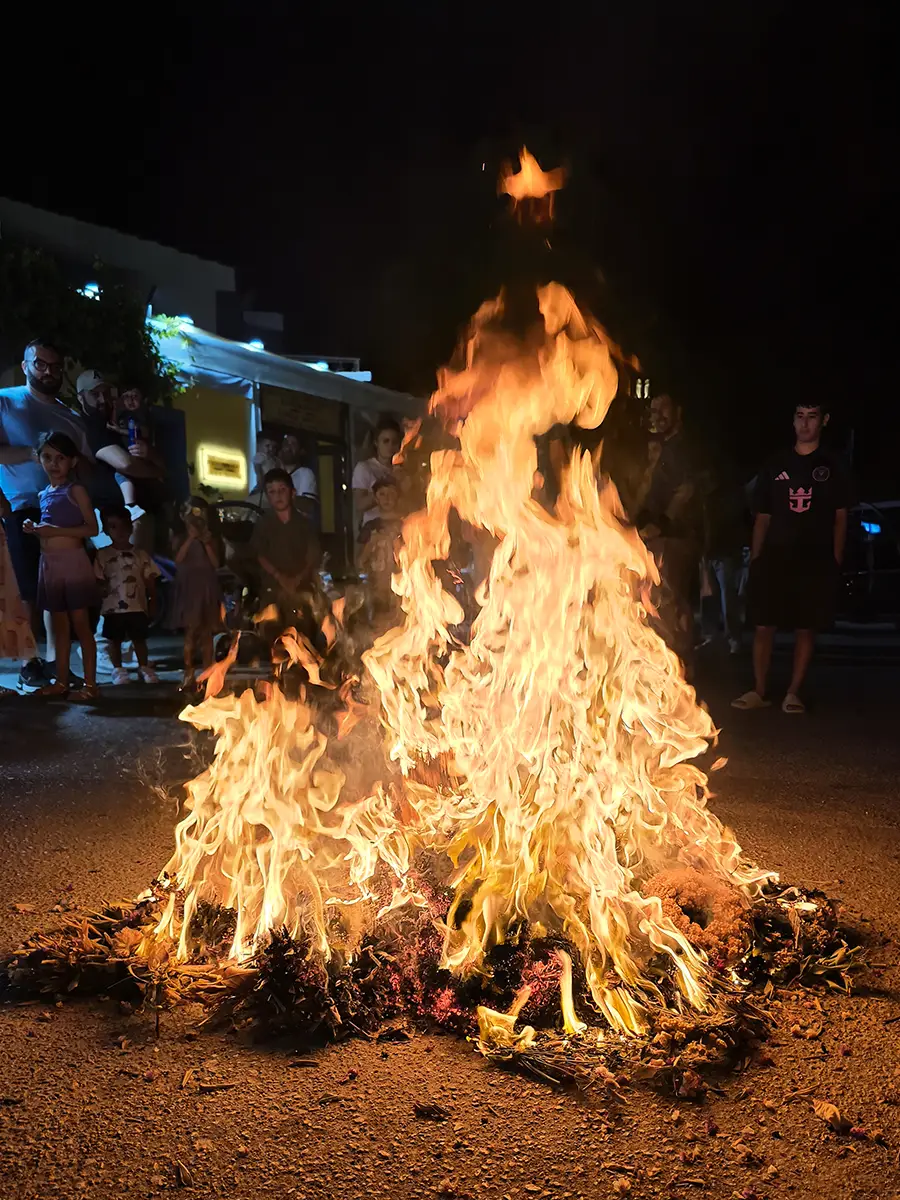
The Feast of St. John Kalafouniaris in Rhodes: Burning the May Day Wreaths
The Feast of St. John Kalafouniaris in Rhodes: Burning the May Day Wreaths
Many of Greece’s most fascinating traditions are shaped by the meeting of ancient folk customs and Christian celebrations. One of the most enduring examples is the feast of the Nativity of Saint John the Baptist or Prodromos (Agios Yiannis), also known across Greece as St. John Kalafouniaris (Ai-Yiannis Kalafouniaris), Kalafounistis, Klidonas, or Rizikaris. Celebrated on June 24, it preserves customs whose origins stretch back to antiquity.
Deeply rooted in Greek folklore, the celebration revolves around themes of purification, renewal, and the transition from spring to summer. It remains one of the most authentic cultural traditions in Rhodes, offering visitors a rare glimpse into customs that have been passed down through generations.
A Beloved Summer Tradition in Rhodes
For the people of Rhodes, the Feast of St. John Kalafouniaris is among the island’s most cherished celebrations. Although the festivities were once observed more widely and with greater intensity, the tradition continues to thrive in many villages through the efforts of local cultural associations.
The celebration provides a unique opportunity to experience authentic Rhodian culture beyond the island’s famous beaches, medieval monuments, and popular tourist attractions. Visitors who happen to be in Rhodes in late June can witness a living tradition that remains deeply connected to local identity and community life.
The Fire Ritual: Jumping Over the Flames
The most iconic and visually striking custom of the celebration is the burning of the May Day wreaths. On the evening of June 23, the eve of the Feast of the Nativity of St. John the Baptist, bonfires known locally as Kalafounoi are lit in village squares across Rhodes. These ceremonial fires are the reason the saint is locally known as St. John Kalafouniaris or Kalafounistis
In earlier times, bonfires were lit in every neighborhood, creating a spectacular scene throughout entire villages. Today, many communities continue the tradition in central gathering places, preserving its communal spirit and cultural significance.
As the flames rise, residents burn the flower wreaths that have hung on their doors since the May Day celebrations. This symbolic act marks the end of spring and welcomes the arrival of summer. The custom reflects ancient beliefs about seasonal transitions, renewal, and the cleansing power of fire.
Once the bonfires are blazing, participants traditionally leap over the flames three times. According to local folklore, this ritual wards off negative influences, brings health and good fortune, and symbolizes a fresh beginning. Many scholars believe the practice has roots in ancient purification ceremonies associated with the summer solstice, when fire was seen as a powerful force of protection and transformation.
The evening unfolds as a lively celebration filled with traditional music, folk dancing, local food, and community gatherings. For visitors, it offers an unforgettable opportunity to experience one of Rhodes’ most authentic cultural events.
The Ancient Mystery of Klidonas
In many parts of Greece, the Feast of St. John Kalafouniaris is also linked to the tradition of Klidonas, an ancient folk divination ritual. The word “Klidonas” comes from ancient Greek and refers to a prophetic sign or omen. According to folklore, this was a day when hidden truths about the future could be revealed, especially matters concerning love and marriage.
The ritual began on the eve of the feast when an unmarried young woman would collect what is known as “Amilito Nero” (Silent Water) from a spring or well. During the journey , she was expected to remain completely silent, as people believed this silence endowed the water with mystical powers.
The girls would then place small personal objects, often rings or charms, into a water-filled container. The vessel was covered and left outdoors overnight beneath the stars.
The following day, villagers gathered in the main square for the unveiling. A child or elderly woman would remove the objects one by one while another participant recited humorous, symbolic, or prophetic verses. Each verse was believed to predict the future of the object’s owner, most often relating to romance and marriage.
A Living Piece of Rhodian Heritage
Despite the changes of modern life, the Feast of St. John the Kalafouniaris continues to be celebrated in Rhodes as a vibrant expression of the island’s cultural heritage. The bonfires, songs, legends, and rituals serve as reminders that traditions survive through community participation and the passing of knowledge from one generation to the next.
Today, the festival is far more than a religious observance. It is an important symbol of Rhodian folklore and cultural identity, offering visitors an authentic and memorable cultural experience. For travelers seeking to discover the traditions, legends, and local customs of Greece, the celebration of St. John in Rhodes remains one of the island’s most captivating summer events.
More posts